Cambridge PilotX

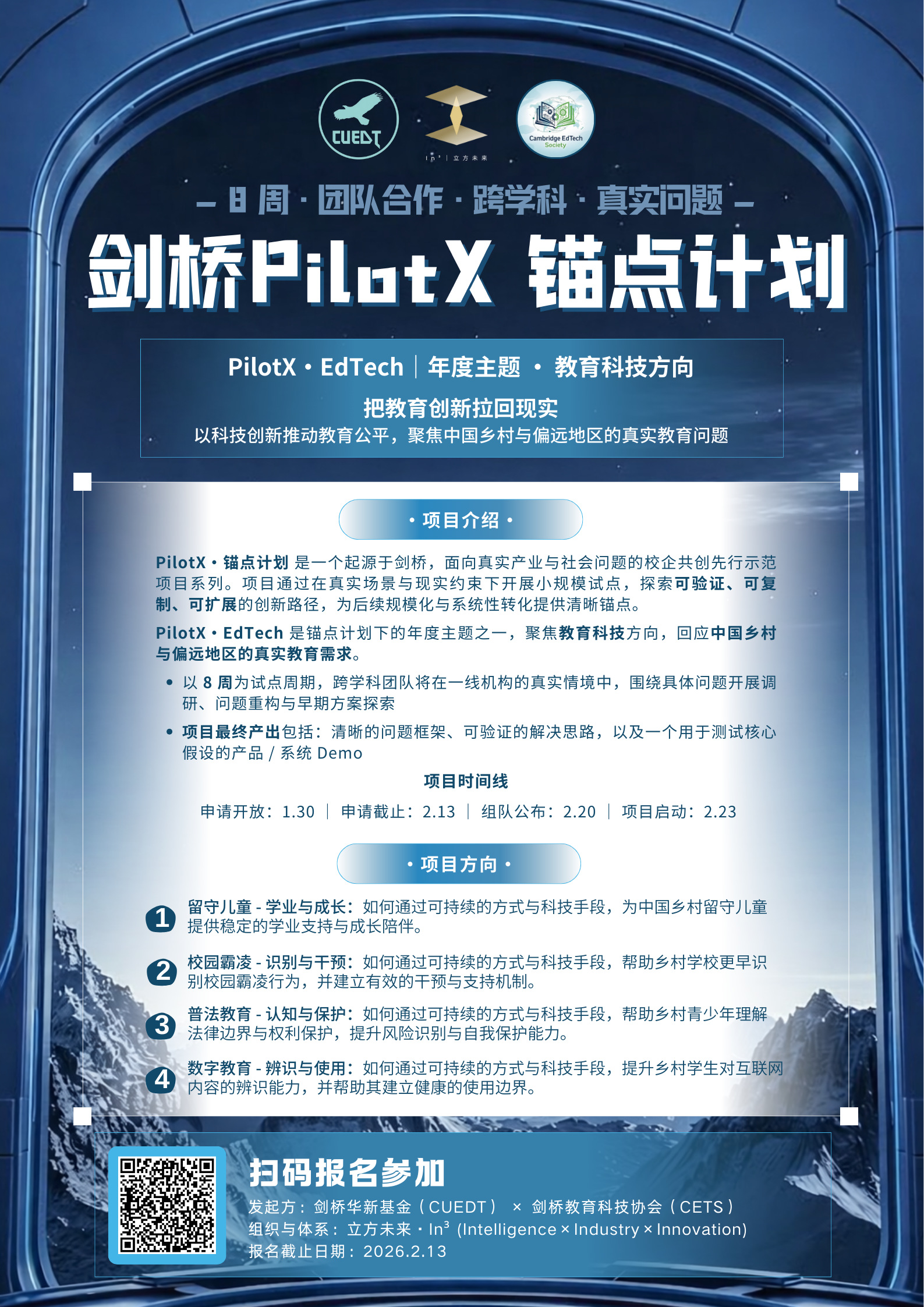
Cambridge PilotX · Education Technology Track

CUEDT × CETS × In³
University–Industry Co-Creation Flagship Pilot | Applications Now Open

Bringing Educational Innovation Back to Reality

Advancing educational equity through technology, with a focus on real educational challenges in rural and remote regions of China

PilotX · EdTech

PilotX · EdTech is an 8-week education technology co-creation pilot programme, jointly initiated by the Cambridge China Education Development Trust (CUEDT) and the Cambridge Education Technology Society (CETS), and organised and delivered by In³ (In Cubed | 立方未来).

PilotX · EdTech is one of PilotX's annual thematic tracks, focusing on education technology and responding to concrete educational needs in rural and remote regions of China. In education, challenges are often complex and long-standing.

In the public and non-profit domain, needs are clear, yet sustained and systematic technical investment is often absent.

Many problems that should be addressed do not disappear through market mechanisms alone.

For this reason, PilotX is not a project about pitching ideas or competing through presentation.

Instead, it emphasises deep, sustained inquiry: understanding the structure and constraints of real problems through research, and then building early-stage technical prototypes or system designs that can begin to function under real conditions—creating a verifiable starting point for future pilots, refinement, and scaling.

Programme Structure & Content

+

The programme runs for 8 weeks, with participants working in interdisciplinary teams of 5–6 people. Overall workload is carefully managed to remain sustainable. Collaboration is primarily conducted online, with teams assigned by the organisers.

Weeks 1–4 | Problem Understanding & Structural Analysis

Participants will:

  • Review and synthesise real background materials provided by frontline organisations
  • Understand the concrete contexts in which problems occur through discussion, interviews, or case analysis
  • Deconstruct problem structures and identify key constraints and core challenges
  • Form hypotheses and continuously refine them through iterative discussion

Weeks 5–8 | Solution Exploration & Prototype Validation

Participants will:

  • Explore multiple possible pathways rather than starting from predefined conclusions
  • Translate understanding into concrete forms such as product concepts, system designs, or service processes
  • Build prototypes that can be demonstrated, discussed, and tested (AI-assisted development is permitted)
  • Iterate continuously based on feedback from mentors and the project team

By the end of the programme, each team will deliver a practical starting point that can be further tested and expanded.

Preview of Exploration Directions

Left-Behind Children in Centralised Care Settings

+

In some rural areas, children who were previously cared for by extended family are increasingly placed in centralised boarding or custodial environments.

While basic living needs are met, long-term companionship, emotional support, and psychological safety are often severely lacking.

The issue is rarely a single dramatic incident. Instead, children gradually become silent, withdrawn, and distrustful—changes that are difficult to detect early.

This project explores whether technology can support ongoing emotional expression, early risk identification, and cross-institutional communication without increasing the burden on caregivers.

Possible outputs include (but are not limited to):

  • Emotional expression or companionship-oriented digital tools
  • Early risk identification support systems for caregivers
  • Low-cost information coordination mechanisms between schools, care institutions, and families

Bullying in Rural School Environments

+

Bullying in rural schools is often hidden, persistent, and occurs in areas with limited supervision. Even when discovered, schools frequently lack the capacity for sustained follow-up or professional support.

The core challenge is not visibility alone, but whether there are people and mechanisms capable of consistently responding.

This project explores whether, under conditions of limited teaching resources, technology and system design can enable earlier detection, easier help-seeking, and sustained support.

Possible outputs include:

  • Student-friendly help-seeking and feedback tools
  • Lightweight identification and documentation systems for teachers
  • Sustainable, school-internal support process designs

Legal Awareness Gaps and Real-World Risks for Rural Adolescents

+

In some rural regions, adolescents face higher environmental risks but have limited understanding of legal boundaries, rights protection, and risk response.

When risks arise, silence often feels like the safest option—not due to indifference, but due to uncertainty about how to act.

This project explores whether technology and design can translate abstract legal knowledge into understandable and actionable support pathways.

Possible outputs include:

  • Contextualised legal awareness and risk simulation tools
  • Safety help-seeking pathway systems for students
  • Risk identification and referral support frameworks for schools

Insufficient Content Discernment and Internet Addiction Risks

+

For many rural students, the internet is not only a source of information, but also a form of companionship and emotional outlet.

Addiction is not merely a matter of screen time—it results from content mechanisms, emotional needs, and insufficient real-world support.

This project focuses not on restriction, but on how technology and design can help students build discernment, usage boundaries, and self-regulation capabilities.

Possible outputs include:

  • Lightweight tools for content discernment and media literacy
  • Usage boundary and self-regulation support systems
  • Low-cost guidance mechanisms supporting home–school collaboration

Frequently Asked Questions

Who Is This Programme Best Suited For?

+

There are no formal disciplinary requirements, but participants from the following backgrounds may find the programme especially suitable (including but not limited to):

  • Computer Science / Engineering / AI / Data-related fields
  • Design / Interaction Design / Service Design / Product Design
  • Education / Psychology / Sociology / Anthropology
  • Public Policy / Law / Public Administration
  • Business / Management / Entrepreneurship
  • Or those actively exploring interdisciplinary or cross-domain pathways

More important than your background is whether you are willing to:

  • Work closely with people from different disciplines
  • Accept that ideas may be overturned and rebuilt
  • Spend time truly understanding problems before attempting to solve them

What Support Will You Receive During the Programme?

+

To ensure exploration remains grounded in reality, each team will receive ongoing support:

  • Mentors from frontline organisations or relevant domains, offering direct feedback and real-world context
  • A PilotX Project Manager, supporting pacing, methodology, and directional clarity

Mid-term and final reviews that focus not on aesthetic polish, but on depth of problem understanding and real-world viability.

What Will You Gain from Completing PilotX?

+

For participants who engage seriously, PilotX offers tangible and extendable outcomes:

  • Showcase and exchange opportunities at Cambridge and partner platforms, including PilotX Demo Day / Public Showcase
  • Prize pool support: this cohort features a RMB 10,000 prize pool to support participant engagement
  • Incubation and follow-up opportunities for projects with demonstrated real-world value, including further product development and pilot testing
  • Like-minded collaborators: you will work alongside peers who are willing to invest time and care into understanding complex problems—trust and alignment built here may become the foundation for future collaboration
  • A high-quality, complete, and credible project experience, covering problem understanding, exploration pathways, and demonstrable prototypes

Application Timeline

Jan 30
Applications Open
Feb 13
Application Deadline
Feb 20
Team Allocation Announced
Feb 23
Programme Start

The PilotX·EdTech Edition is open to currently enrolled university students worldwide, with no disciplinary restrictions. Applicants from diverse academic and geographic backgrounds are welcome.

Places are limited. Selection and team formation will be based on application review.

The programme adopts a rolling admission process. Applicants are encouraged to apply early. Before February 20, shortlisted candidates may receive interview invitations—please monitor your email inbox.

Ready to Join Us?